
So Union Budget 2026 was presented on February 1, 2026, and lakhs of government employees were waiting to hear one thing – when will the 8th Pay Commission salary hike start? But guess what? Nothing was announced. Let me explain why.
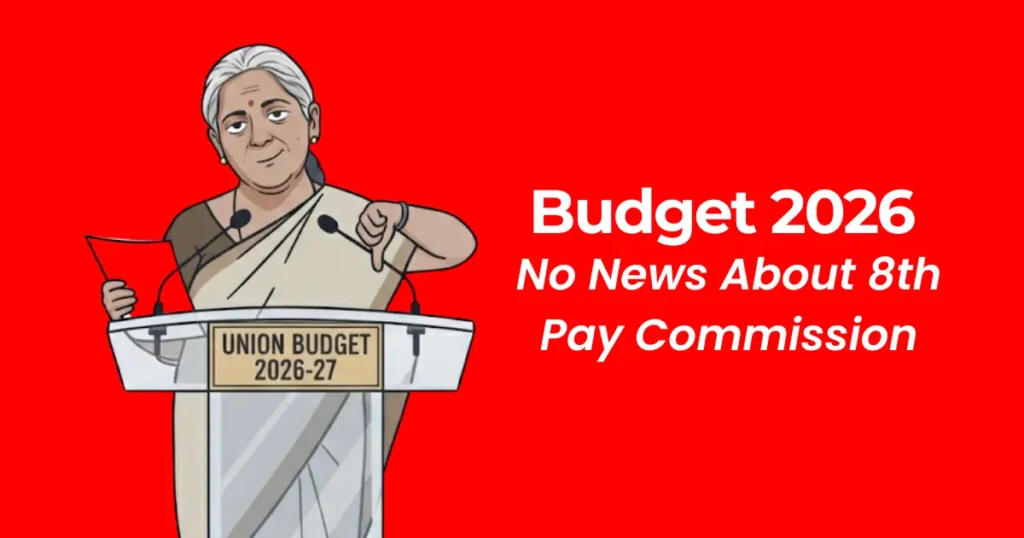
Table of Contents
What is 8th Pay Commission? Simple Explanation
Before we talk about Budget 2026, let’s understand what this Pay Commission thing actually is.
Pay Commission is basically a committee that the government makes every 10 years. This committee looks at government employees’ salaries and says – “Boss, these salaries are too old now. Life has become expensive. Inflation has increased. Let’s increase the salary.”
History Pattern:
- 6th Pay Commission – Started from January 1, 2006
- 7th Pay Commission – Started from January 1, 2016
- 8th Pay Commission – Expected to start from January 1, 2026
So basically, every 10 years, the government reviews and increases salaries. That’s the pattern.
Who Benefits from 8th Pay Commission?
This is important for understanding who’s waiting for this news:
Central Government Employees: Around 50 lakh people working in central government offices, railways, post office, etc.
Pensioners: Around 65 lakh retired government employees who get pension.
Total: More than 1 crore (1.15 crore) people are waiting!
That’s a LOT of families. Imagine 1 crore people and their families – maybe 4-5 crore people in total are affected by this.
Why Nothing Was Announced in Budget 2026?
Many government employees had hopes. They were thinking – “Maybe today FM will announce something about our salary hike.” But that didn’t happen.
Here’s why:
1. Commission Just Started Recently
The 8th Pay Commission was officially approved only in January 2025. That’s just about a year ago, okay. The committee has been given 18 months to study everything and give recommendations.
Think of it like this – you can’t cook biryani in 5 minutes, no? It takes time. Same way, Pay Commission also takes time.
2. They Have to Study Many Things
The Pay Commission committee has to look at:
- Current economic situation of India
- Inflation rates
- Cost of living
- Government budget capacity
- How much money government has
All this research takes time.
3. Budget is Not the Place for Pay Announcements
This is something many people don’t know. Budget is about government’s income and expenses for the year. Salary hike announcements don’t come in Budget speech usually.
They come separately after Pay Commission completes its work.
When Will the Salary Actually Increase?
Let’s be realistic here. Based on how things work:
Timeline:
- January 2025: 8th Pay Commission approved
- Now (February 2026): Commission is doing research and meetings
- Mid-2027: Expected to submit final report (18 months from start)
- Late 2027 or 2028: Government will review and approve
- FY 2028: Actual implementation might happen
So realistically, don’t expect salary hike before 2028.
But here’s the good part: When it’s implemented, it will be retrospective from January 1, 2026. That means you’ll get arrears (backpay) for all the months from Jan 2026 till implementation date.
For example, if implemented in April 2028, you’ll get arrears for about 27 months! That could be a big lump sum amount.
What Salary Hike Can You Expect?
According to experts and reports, here’s what’s expected:
Expected Fitment Factor: 1.83 to 2.46
“Fitment factor” is basically a multiplication number. Current salary × Fitment factor = New salary.
Estimated Salary Increase: 30% to 34%
Example:
If your current basic salary is ₹20,000 per month:
| Fitment Factor | New Basic Salary |
| 1.83 | ₹36,600 |
| 2.46 | ₹49,200 |
That’s a big jump!
Minimum Basic Salary Expected:
Currently under 7th Pay Commission: ₹18,000
Expected under 8th Pay Commission: ₹41,000 to ₹51,000
English Language Connection – Why This Matters
You know what’s interesting? Many government employees’ children study in English medium schools these days. Why? Because parents want their kids to have better opportunities.
When I was researching about this, I realized something. Government employees in cities especially make sure their children learn daily use English conversation. They send them to spoken English classes, buy English grammar books, make them watch English movies.
Why this effort? Because they know that in today’s world, English opens doors. Whether it’s government exams, private jobs, or going abroad – English is important.
What is a Verb in Simple Terms?
Even in learning English, basics matter. Like understanding what is verb. A verb is simply an action word – something you do. “Eat”, “sleep”, “work”, “study” – these are all verbs.
In Marathi, we have similar concept. Marathi verbs like “khaane” (to eat), “jaane” (to go), “kaam karane” (to work) – these show action, no?
Daily English for Government Employees
Many government employees nowadays are learning English because:
- Government forms and files are increasingly in English
- Computer systems use English
- Email communication requires English
- Children ask parents for English help in homework
So when salary increases through 8th Pay Commission, many families are planning:
- “We’ll put kids in better English medium school”
- “We’ll send them for spoken English classes”
- “We’ll buy English learning books and materials”
Education is always top priority for Indian families.
Understanding Marathi Verbs and English Learning
For those from Maharashtra and other Marathi-speaking regions, let me connect this in a way you’ll understand.
In Marathi, we use verbs daily:
- Jaane (जाणे) – to go
- Karane (करणे) – to do
- Bolne (बोलणे) – to speak
- Shikaane (शिकणे) – to learn
- Vaachane (वाचणे) – to read
These are all action words. Same concept exists in English as verbs.
Many government employees from Maharashtra tell me – “When our salary increases, we want to give our kids better English education.” Because they understand that learning verbs in English, understanding grammar, practicing daily use English sentences – all this helps their children succeed.
It’s all connected, you see. Better salary → Better education for kids → Better future.
The Current DA (Dearness Allowance) Situation
Here’s some good news though. Even though 8th Pay Commission isn’t implemented yet, there’s one thing happening:
DA continues to increase every 6 months!
Currently, DA is at around 55-58% of basic salary. It keeps increasing to match inflation.
What is DA?
Dearness Allowance is extra money government gives to help with inflation. When prices of vegetables, petrol, everything increases – DA also increases.
So even though 8th Pay Commission hasn’t come, your salary keeps getting small increases through DA. It’s not a big jump, but better than nothing, right?
Why Are Government Employees Upset?
Let me be honest here. After Budget 2026, many government employee unions are angry. Some are even planning protests on February 12, 2026.
Their complaint:
“Government approved 8th Pay Commission in January 2025. It’s been more than a year now. Still nothing concrete. We want faster action.”
What they’re demanding:
- Speed up the process
- Make announcements about timeline
- Start consultations with employee unions
- Give some interim relief
Union leaders are saying – “We understand it takes time. But at least tell us clearly when we can expect it. Don’t keep us in dark.”
This frustration is understandable, no? When you’re planning your family budget, children’s education, house loan EMI – you want to know when your salary will increase.
The Real Picture: When to Actually Expect Money
Let me give you the honest picture based on past patterns:
What Happens After Pay Commission is Approved:
Year 1 (2025): Commission formation and initial meetings
Year 2 (2026-2027): Research, consultations, discussions
Year 3 (2027): Final report submission
Year 3-4 (2027-2028): Government review and approval
Year 4 (2028): Actual implementation
So realistically, expect money in your bank account by 2028.
The Wait is Long But…
Remember two good things:
- Arrears: You’ll get backpay from Jan 2026, so a big lump sum
- DA continues: You’re still getting regular DA increases
How Much Arrears Can You Expect?
If implementation happens in 2028, you could get arrears for about 24-30 months.
Rough Calculation:
Let’s say your salary increases by ₹10,000 per month after 8th Pay Commission.
If you get 24 months arrears: ₹10,000 × 24 = ₹2,40,000 lump sum!
For higher level employees with bigger salary increases, arrears could be ₹4-5 lakh or more.
That’s a substantial amount. Many employees are planning:
- Pay off part of home loan
- Children’s education expenses
- Buy a vehicle
- Save for emergencies
Daily English Usage and Career Growth
Coming back to the English language connection – I’ve noticed something interesting.
Many government employees are now focusing on daily use English conversation skills because:
- Promotion exams often have English papers
- Computer work requires English knowledge
- Departmental exams have English sections
- Communication with senior officers needs proper English
So while waiting for 8th Pay Commission salary hike, many smart employees are investing time in learning:
- English grammar basics
- Common English verbs (action words)
- Daily conversation sentences
- Official letter writing in English
This is smart planning. Better English skills → Better performance → Better chances of promotion → Even higher salary!
What About State Government Employees?
Important point: 8th Pay Commission is only for Central Government employees.
If you work for State Government (like Maharashtra Government, UP Government, etc.), you have to wait for your state to announce State Pay Commission.
Usually, states follow central government’s pattern but with some delay. After Central Pay Commission is implemented, states study it and then implement their own version.
So state employees might have to wait even longer – maybe till 2029-2030.
Pension Increase for Retired Employees
This is equally important for 65 lakh pensioners.
When 8th Pay Commission is implemented, pensions will also increase. The fitment factor applies to pension too.
Current minimum pension: ₹9,000 per month
Expected minimum pension: ₹20,000 to ₹25,000 per month
This will be a big relief for retired government employees. Many are struggling with medical expenses, house rent, and daily needs on current pension.
Financial Impact on Government
This is why implementation takes time. The government has to arrange money for this.
Estimated cost of 8th Pay Commission: ₹2.4 lakh crore to ₹3.2 lakh crore
That’s a HUGE amount! To put in perspective:
- 7th Pay Commission cost: ₹1.02 lakh crore
- 8th Pay Commission cost: About 3 times more!
Why so much? Because:
- More employees now (50 lakh vs earlier)
- More pensioners now (65 lakh vs earlier)
- Bigger salary hikes expected
So government needs time to plan budget and arrange this money.
Should You Stop Waiting and Plan Ahead?
My honest advice: Don’t keep all your life plans on hold waiting for 8th Pay Commission.
Do this instead:
- Continue current financial planning – Don’t wait to start saving, investing, or important purchases
- Focus on skill development – Learn new things, improve English, take up courses. This will help in career growth regardless of pay commission
- Manage with current salary – Budget properly with what you’re earning now plus regular DA increases
- Plan for arrears wisely – When you get lump sum arrears in 2028, use it wisely – not for luxury spending
- Track updates – Keep checking official government notifications for actual announcements
Common Questions and Answers
Q: Will Budget 2027 announce 8th Pay Commission?
A: Unlikely. Budget doesn’t usually announce salary hikes. Wait for Pay Commission report.
Q: Can government speed up the process?
A: Technically yes, but it requires proper study. Rushing might lead to incomplete recommendations.
Q: Will DA be merged with basic salary?
A: Not officially confirmed yet. Government has said DA will continue separately for now.
Q: What if I retire before implementation?
A: You’ll still get pension increase when implemented, with arrears from Jan 2026.
Q: Should I take loan expecting salary increase?
A: No! Don’t take loans based on future expectations. Very risky.
So to summarize everything:
What Happened: Budget 2026 had no announcement about 8th Pay Commission salary hike
Why: Because Pay Commission work takes 18 months minimum, and it was just formed in 2025
When to Expect: Realistically 2028, but with arrears from January 2026
How Much: Expected 30-34% hike depending on fitment factor
What to Do: Don’t just wait. Use this time to improve yourself, especially skills like English which help in career growth
Final Message: Be patient but proactive. Good things take time!

I am Ashiwini Pandey, a passionate blogger and digital entrepreneur. Since 2016, I have been actively engaged in the world of blogging and digital marketing. Over the past decade, I have built and managed my own digital marketing agency, helping businesses establish their online presence, grow their reach, and achieve measurable results.